This strategy explores how we can use a wide range of technologies that are not only better for the environment but are also maintainable. If we want to produce garments that are more ecologically friendly then we should make sure that all the procedures used in the design process are cleaner and better.
Having already identified Issey Miyake's brilliant A-POC garment designs and studied Sandy Black's knit to fit I thought I would try to uncover new and brilliant ways to produce objects/garments and identify innovative technology.
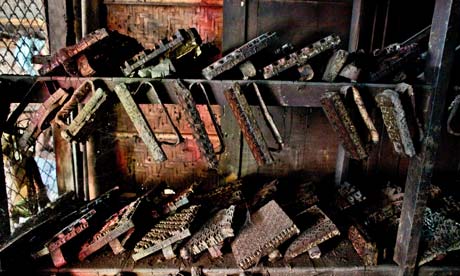
BATIK
Batik, an ancient wax-resistant dying technique highly developed in Indonesia and used to represent their culture has been found to have a major impact on the environment. Batik businesses produce more CO2 emissions than any other small or medium enterprise in Indonesia. According to reports in 2009 there were 50,000 batik-producing companies each one consuming a high amount of fossil fuel (kerosene) and electricity, not to mention toxic dyes and excessive water consumption. Since then there has been a four-year programme set up by The Clean Batik Initiative to promote sustainable practices and "The programme assists batik SMEs [small or medium-sized enterprises] in implementing cleaner, safer and more efficient production."
Since then CBI has developed an electric stove with a thermostat that uses a fraction of the kerosene that traditional fuelled stoves use in order to heat the wax for cloth application. Not only is this adopting more sustainble practices but it also cuts down production costs making it win-win for the consumer and manufacturer. CBI programme advisor Micahel Grotehusmann has also begun reducing damage from harmful dyes by purpose building a reservoir to collect these dyes. This has successfully produced a 4% reduction in water usage and whats more Groteshusmann has begun to source only natural dyes promoting a far more sustainable consumption. "In just over a year, 10% of our SMEs have switched to using natural dyes completely," said Grotehusmann. "(The Guardian)
COULD 3D PRINTING END OUR THROWAWAY CULTURE?
FREEDOM OF CREATION - RAPID PROTOTYPING
Wouldn't it be fantastic if instead of printing just a regular 2D image or even just a boring document we could print out our own products and objects in a wearable 3D format?
We as consumers want the newest most fashionable items in the market and will do whatever it takes to get them even if it means throwing our old stock into landfill. The fact that product lifespans are decreasing and hundreds of new products are being released to the market each day makes us forget the damaging effects on the environment. Most products these days are generically tailored for the unidentified masses thus decreasing the value for the individual and increasing waste for our planet. Most stock is produced with high manual labour at huge factories that churn out massive amounts of dyes and waste fabric daily.
Freedom of Creation has taken account of this and have used the growing technology and digital products on the market as a platform for change. They have considered the idea of 3D printing, a way to design your own product and print it out so not only is it unique and personal to you but it also decreases the amount of waste entering the environment. Their concept transforms a CAD file into a real object via a printing process that adds one layer of matter onto the other until an entire object has been generated. The objects below are products of a 3D print machine and the video showcases how the trainers are made. The Freedom of Creation Collection applies localised just-in-time production and short distance distribution logistics cutting down on transportation pollution and cost.


Permanent collection at Museum of Modern Art, New York.
The making of Onitsuka Tigers Electric Tiger Land. (Youtube)
Janne Kyttanen the company's founder and creative director remarked;
'I can measure your body, in 3D, and I can make you perfectly fitting garments in the future without any sewing and stitching, making the needle and the thread obsolete.'
I love this idea as you can literally feed the machine a design and it will come out as a useable object! It eradicates the need to create prototypes out of foam or cardboard as CAD does it for you. The design can also be shared amongst friends via emails for them to print out, therefore what can be produced in one place can also be produced worldwide. There are even cradle-to-cradle aspects as David Flanders; technology enthusiast and blogger based in London, reports for a similar company RepRap. He exclaims;
"Imagine I print you a shoe. Your child grows, as they do. You take that shoe, you throw it back in the shredder - the shredder then processes the plastic. You scale up your design 0.3% and you've got your child's next shoe. That's the type of imaginative excitement that we really are talking about."
In the future I think this will be remarkable as when an item breaks and you have no clue where it was from you could quickly re-design the broken part and reprint it, saving money on buying it new or time scouring the shops!

No comments:
Post a Comment